The NHS Ten Year Plan and Your Foundation Trust Members: What Happens Next?
The government’s Ten Year Health Plan, published in July 2025, sets out the most ambitious restructuring of the NHS in a generation. Built around three core shifts — from hospital to community, from illness to prevention, and from analogue to digital — it promises to reshape how care is delivered across England. But buried within the broader headlines about neighbourhood health centres and integrated care is a change that has profound implications for every Foundation Trust in the country: the removal of the requirement to maintain a council of governors.
For Trust membership and engagement teams, this raises an immediate and uncomfortable question: if the statutory framework that underpins our membership model is being dismantled, what happens to the relationships we’ve spent years building?
A Period of Genuine Uncertainty
The Ten Year Plan proposes to “reinvigorate and reinvent” the Foundation Trust model, with an ambition that every NHS provider should hold FT status by 2035. High-performing Trusts will have the opportunity to become Integrated Health Organisations (IHOs), holding entire health budgets for local populations. The first wave of eight Advanced Foundation Trusts was announced in November 2025, with assessments beginning this year.
Crucially, though, the plan removes the requirement for governors entirely — replacing the current model with an expectation of “more dynamic arrangements to take account of patient, staff and stakeholder insight.” What those arrangements look like remains undefined. There is no detailed implementation plan for the governance changes, and further guidance is expected to emerge over the coming months and years.

That sentiment, echoed by Trust teams across the country, captures the challenge perfectly. The need for public engagement isn’t going away — if anything, the emphasis on community-based care and population health outcomes makes it more important than ever. But the structures through which Trusts have managed that engagement are changing, and nobody yet knows exactly how.
Why This Moment Demands Flexibility
This uncertainty creates a very specific technology challenge. Trusts that are locked into rigid, proprietary CRM systems face a difficult period. If your membership management platform was built to serve a single governance model, what happens when that model is reformed? If your per-user licence costs are tied to a membership team that might be restructured, how do you maintain continuity of engagement without spiralling costs?
The Trusts that will navigate this transition most successfully are those whose technology can adapt as requirements evolve — not systems that require expensive reconfiguration every time policy shifts.

Open Source CRM: Built for Exactly This Scenario
This is precisely the context in which open-source CRM — specifically CiviCRM, the platform that underpins our TrustCRM service — comes into its own. When you don’t know what the future governance model will look like, the last thing you need is a proprietary platform with rigid structures and escalating fees.
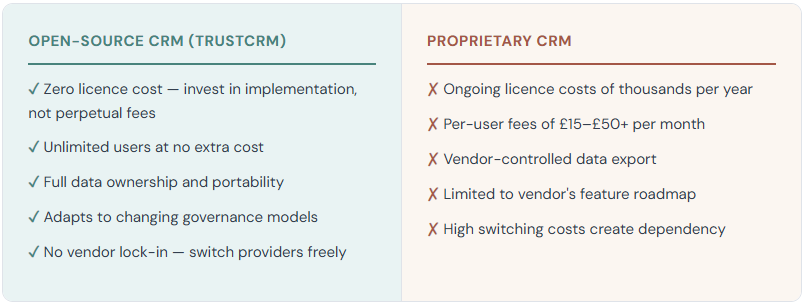
CiviCRM is used by thousands of organisations worldwide, including membership bodies, charities, and public-sector organisations. It provides a complete stakeholder engagement platform — membership management, communications, events, reporting, and website integration — without the per-user licensing costs that make proprietary systems increasingly expensive as engagement broadens.
More importantly, it’s infinitely adaptable. As the Ten Year Plan’s governance reforms take shape, your CRM can evolve alongside them. New membership categories, different engagement models, changed reporting requirements — these are configuration changes, not costly redevelopment projects. Your data remains yours, fully portable and never locked behind a vendor’s proprietary export process.
Protecting Relationships Through the Transition
Whatever form the new governance arrangements take, one thing is certain: Trusts will still need to engage meaningfully with their communities. The Ten Year Plan’s emphasis on population health outcomes, neighbourhood-based care, and patient insight makes public engagement not just desirable but essential. The question is how to maintain those relationships through a period of structural change with minimal overhead and risk.
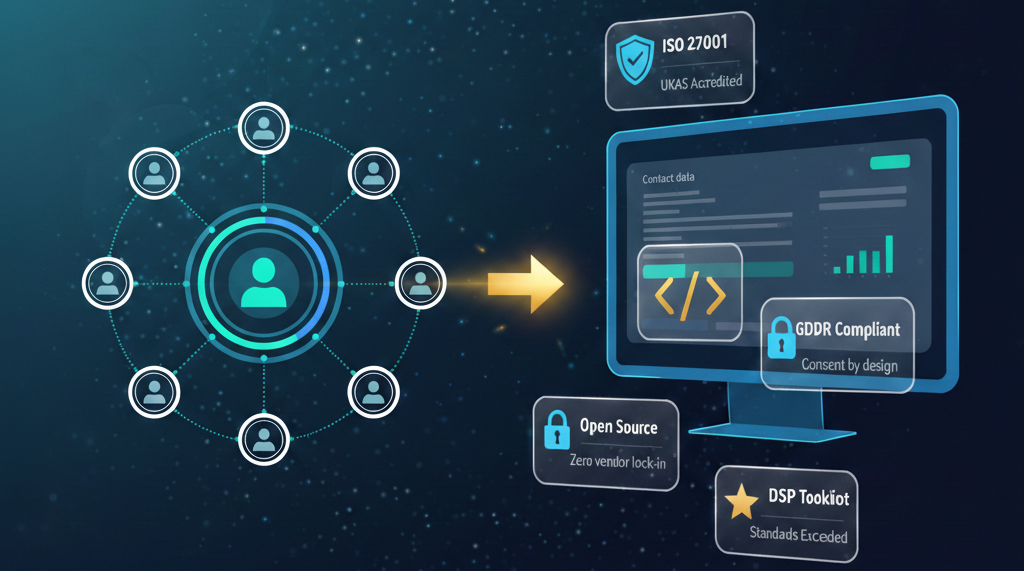
TrustCRM is designed specifically for this context. Built on CiviCRM and integrated with Drupal for public-facing engagement, it gives Foundation Trusts a complete platform for managing members, governors, public contacts, communications, events, and reporting — all from a fully hosted, NHS-grade SaaS environment with nothing to install and access from any browser.
Membership data enriched with ONS socio-economic classification data enables board-ready reporting on demographic representation. Built-in GDPR consent management, data retention policies, and subject access request tools ensure compliance is handled by design rather than bolted on as an afterthought. And because it’s fully hosted in the UK on NHS-grade infrastructure, data sovereignty is never a question.
NHS-Proven, Security-Certified
We understand that NHS procurement requires more than just good technology. enCircle Solutions holds UKAS-accredited ISO 27001 and ISO 9001 certifications, Cyber Essentials Plus accreditation, and has achieved Standards Exceeded on the Data Security and Protection Toolkit. We’re a 100% UK-based team with six NHS Foundation Trusts already running TrustCRM, and we’ve been delivering CiviCRM and Drupal solutions for NHS clients for over a decade.
That combination of open-source flexibility and NHS-grade security assurance is what makes TrustCRM different. You get the adaptability to navigate whatever governance changes emerge from the Ten Year Plan, with the compliance credentials that NHS procurement teams require.
Looking Ahead
The Ten Year Plan is deliberately ambitious and necessarily vague in places. The detail of how governor and membership arrangements will evolve is still emerging. But that shouldn’t be a reason to wait. The Trusts that invest now in flexible, cost-effective stakeholder engagement platforms will be the ones best positioned to adapt — whether that means supporting a reformed governor model, transitioning to new “dynamic engagement arrangements,” or evolving into an Integrated Health Organisation.
If your current systems are costing you per-user fees, locking you into a single vendor, or struggling to adapt to changing requirements, now is the time to explore a different approach.